Monday, 10 October 2016

The grownup by Gillian Flynn

"The grownup" by Gillian Flynn. This book is published by Orian publishing group in 2015 and has 96 pages.

A girl who begged during her childhood and was a hand job specialist turns into a fortune teller and aura reader. Susan comes to her with her problem and takes her to Susan's Victorian mansion. 

Can the fortune teller bluff her way? Can she pretend to help Susan? Or is there more to it?

It's a very good story. It's a thriller through and through. The buildup is slow but once it's done the things happen fast. There are multiple twists towards the end that increase the heartbeats of the reader. The story ends tantalizingly leaving a lot to the fertile imagination of the readers.

There are several possibilities about the reality and it is upto the reader, to decide for oneself, which one to believe. A good formula of success. It's a gripping story where the graph keeps on rising. 

This story has won 'The Edgar award'. Converting an award winning short story, by author of a famous book (Gone girl), into a standalone book is a commercial master stroke by publishers. I happened to notice this book in Bookworld in Dubai mall and read it because of the name of author and because the small size of book piqued my curiosity. Publishers won.

Looks like all Gillian Flynn book covers have got a black background with light colored lines making some kind of pattern. This book is no exception, the pattern being smoke.

Recommend reading but too small to purchase it as a book. Go to the library or borrow.


Thursday, 6 October 2016

Hitman Andres and the meaning of it all by Jonas Jonasson

"Hitman Andres and the meaning of it all" by Jonas Jonasson. This book is published by Fourth Estate in 2016 and has 400 pages. 

Per Persson, a nobody, is a receptionist in a third rate hotel. Hitman Andres, a thrice convict, comes to stay in the hotel. A jobless priestess Johanna Kjellander, who does not believe in God, meets Per. Three of them form a strange alliance and business venture. 

What is the alliance? Has it anything to do with money? Is there violence? How is Jesus involved? What is the connection with Santa?

It's a slapstick comedy where characters do all sorts of nonsensical things. The lead characters act without thinking thereby creating a lot of confusion and funny scenarios. They do all sorts of crazy things but eventually come out unscathed and triumphant. It's the journey that entertains you rather than the outcome. 

Here Hitman, Receptionist and Priest run three different business ventures. Each one very different from other. Jonas has concluded the book with a business venture that is satisfying and gratifying. In short a happy ending. 

The story drags, trundles, rolls, crawls in the general direction of conclusion. Although the narration of the standalone book is entertaining, those who have read the first two books will find it repetitive and monotonous.

Author has little to add in this book that was not there in the previous two. At times I was tempted to abandon. 

This is author's third book. First one was absolutely fantastic. He has a very special dry humor style of narration. Second was less good. This one is even less good. I sincerely hope the author brings something new in his next one. 

Give it a miss.


Tuesday, 4 October 2016

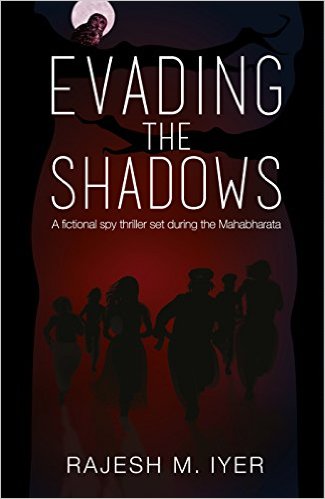
Evading the shadows by Rajesh M. Iyer

"Evading the shadows" by Rajesh M. Iyer. This book is published by Kriscendo Media LLP in 2016 and has 341 pages. 

Pandav's are about to complete there 12 year  vanvas (forest stay) and about to start 1 year agyatwas (incognito stay). Kaurav spies are on their trail. Duryodhan has sent them on a mission to find Pandav because if they are found they would repeat 12+1 year.

Who are the spies? Do they sniff Pandav? Can Pandav outsmart them? Will they get help?

The book cover declares it to be a fictional spy thriller set during Mahabharata. I purchased the book reading that one line. I haven't read much about any attempts by Kaurav to find Pandav during agyatwas except some passing comments. A lot was at stake for both parties during that one year. The game of cat and mouse wpuld be at its peak. So to write a fiction on that aspect is a brilliant idea. Full marks to author's imagination. 

Author introduces a number of fictional characters and events to spice up the story. That makes it interesting. Author has also emphasized that even though Pandav were in disguise, they being human, could not disguise their personality traits. These traits put them in danger and provided leads to Kaurav spies. 

Author has used flash back technique liberally to take the story forward and make his point. The stories in flash back are well known to the readers and some times one feels that they could have been curtailed. 

Something interesting. When there is a change of scene, author has transitioned every time in a very peculiar way. The punch word of the last sentence of previous scene is also the punch word of the first sentence of the subsequent scene. That gives the prose a flair of poetry. Author has managed to narrate a good story that maintains reader's interest. I liked his style. We can expect more good work from Rajesh. 

What is the drawback of this story? Well, unlike any other thriller, reader knows the final outcome. I felt that the book should have ended immediately after revelation if Pandav identity. But author, avoidably, stretches it a bit more. 

Cover design is not impressive. Black shadows on the background of blackish red. Too dark. No recall value. A little more effort would have carried the message and done a lot of good.

Good book. Recommend reading.


Sunday, 2 October 2016

Vikraal by Sangeeta Bahadur

"Vikraal" by Sangeeta Bahadur. This book is published by Pan Macmillan in 2015 and has 516 pages. This is Book 2 of Kaal trilogy. 

Devanampriya and Tejaswi begin their onward journey. There is a burning tree without heat. A prophecy is fulfilled. Agneyi meets Arihant. Prapto has to take a quest on his own but will find a fellow seeker. Aushij is very close to waking up.

Why is the tree burning? What is the prophecy? Will Arihant and Agneyi gel? What is the quest? What is the reward? Will there be a showdown? What is Vikraal? Has Aashman lost his love?

The fascinating tale continues with the same tempo. The miraculous world, events and story retain the captured imagination from Book 1 (Jaal). It's a complex yet interesting story and narration is enticing. 

Devanampriya's fight with dark forces continues. His battles hopping dimensions, stepping time streams go on. However there is a defeat in store for him. His complex mind needs solutions and answers. He can't find them and it results in frustration and insensitive behavior towards those who love him. This Indian superhero develops and gains powers. In Book 1 he undergoes physical metamorphosis, in Book 2 he has self realization. What would it be in Book 3?

Kudos to the author for creating this imaginary world that rivals Harry Potter. Her imagination seems to have no bound. She has done it convincingly. Reader wants to know what next?

Special mention should go to the beautiful names given to all the characters. All the protagonists have beautiful names, but not only them, even supporting and minor characters have beautiful names.

The book ends on a tantalizing climax. Readers will have wait release of Book 3 to know if what appears to have happened, does happen. 

In all trilogies, retaining the tempo, interest and grip in third book and ending it on a high note is the most difficult part. Let's hooe that Sangeeta delivers in Book 3. 

Recommend reading.


Thursday, 29 September 2016

Old stone mansion" by Mahesh Elkunchwar

"Old stone mansion", a play, by Mahesh Elkunchwar, translated from original Marathi 'Wada Chirebandi (वाडा चिरेबंदी)' to English by Shanta Gokhale. This book is published by Seagull in 2004 and has 72 pages. This book was recommended by my father. 

Patriarch of a respected, but almost broke, family is dead. His second son and daughter in law arrive from Bombay. The play is about perspectives of family members towards each other, society and their own future, their relationship with each other and their opinions against the harsh reality of dwindling monetary situation and need to spend for the sake of appearances, social status and prestige. It's the story of transformation of a once wealthy Brahman family in a town in Vidarbha staying in a huge 200 year old stone mansion and hollowed economic situation. 

When you read a play, the characters and their relations with other characters are not explained by author like in a novel. Here these things are slowly unveiled through the dialogues. That's the beauty of play.

There are a number of tiffs in the play. Rich and poor, city and town dwellers, deshasta and koknastha, young and old, opportunists and naives etc. There is love between the family members but it is time and again measured with the economic yard stick. 

Characters are rich. Blind and deaf grandmother who is stuck in time and calls her son. Mourning, loving Aai whose opinion does not count, Bhaskar the opportunist elder brother who is not able to retain the lifestyle, Vahini his wife, Parag their son who is in bad company, Ranju their daughter who is dreaming about acting in films, Sudhir the middle son who works in Mumbai, Anjali his Koknastha (A Brahman sub cast) wife, Chandu the youngest son ordered by all and Prabha their sister who has been subjected to injustice. 

The character of Vahini (Eldest daughter in law of the family) is most interesting. She demonstrates a lot of shades. She is responsible, works a lot, keeps her husband in check, adores her brother in law, keeps ordering her youngest brother in law, is blindsided with her love for her children and can't see the inevitable, has taken control of the house. Probably the most developed character.

Translation is OK. In some cases it is a transliteration rather than translation. For example Vahini keeps saying 'pest'. I wondered why she uses the word out of context. Then I realized that probably the original Marathi play used the expression 'jalla (जळ्ळं)'. Also the change in spoken Marathi in Warhad and in Kokan that shows the tiff in family is lost in translation.

It's a powerful play of transitions and lack of adaptability. I have not watched this play on stage but it was one of the classics. It was revived recently and is running currently.

Special mention should go to the title of the play, both original and translation. It's so perfect that there couldn't have been a better name. The name says it all. 

Read the original in Marathi. Or better watch it.


Tuesday, 27 September 2016

A mysterious death at Sainik farms by Rukmani Anandani

"A mysterious death at Sainik farms" by Rukmani Anandani. This book is published by Rupa publications in 2012 and has 240 pages.

Ugrasen, a wealthy businessman and father of three adult sons, is dead in his house full of family and relatives. There is a typewritten note. Private Investigator Ganapaty Iyer and his side kick Vinayak Verma, luckily, land their first case in Delhi.

Is the death a murder? Can GP successfully investigate? Will police cooperate? Whodunit?

A big rich family, patriarch murderd, lot of suspects, most of them with motives, slow story, meticulous investigations, assembly at the end to reveal the murderer. Sounds familiar? This can be the synopsis of most of Agatha Christie books. So is it for this book. While reading the book you get a feeling that you are reading an Agatha Christie's Indian novel. 

Characters are good. Bossy father, Suppressed and rebellious sons, a femme fatale, jeleous wife, dubious brother, friendly sister-in-law, sharp niece, dependent relatives, impatient police, smart but not that smart side kick and finally logical, deductive, methodological detective.

To add some differentiating factor, here is a detective (GP) who can recite verses from Kural of Tamil poet Tiruvalluvar, at will, appropriate to the occasion.

I was able to recognize the killer half way through the book. GP finds the killer based on other clues, not the one I used for my deduction. Should ask the author if my deduction is also valid.

One thing that escapes the reader is how GP can be so confident, convincing and all knowing in his first case. Reason for missing will is also weak. 

Cover shows an old wooden rocking chair at night, on the background of a wall with peeling paint and plaster. I was not able to determine how exactly is this cover relevant to the story. 

Based on how the novel ends, it is evident that Rukmani is planning to write a series for this lovable private investigator Ganapaty Iyer. Would like to read another one. 

Read if you like Agatha mysteries.


Monday, 26 September 2016

The Hidden Oracle by Rick Riordan

"The Hidden Oracle" by Rick Riordan. This book is published by Puffin in 2016 and has 432 pages. This is Book 1 of 'The trials of Apollo', a new series on Greek mythology. 

Apollo, God of music, poetry, art, oracles, archery, plague, medicine, sun, light and knowledge, finds himself transformed into Lester Pappadopolus, a 16 year old youngster and to his horror, a mortal. 

Why has he become a mortal? What did he do? What trails await him? Can he survive without his Godly powers?

After dabbling in Egyptian (Kane chronicles) and Norse mythology (Magnus Chase series), Rick is back to his favourite Greek mythology. He has already written two series on Greek mythology, both featuring Percy Jackson. Percy Jackson makes an appearance at the start and towards the end of this book. Here he is in supporting role rather than being the protagonist.

In the first series Cronus was the villain, in second Gia was the villain. In this series, Roman emperor Nero and the Python are the villains. Both have come back from dead.

Apollo and Calypso have acquired a mortal form. Leo is missing after battle with Gia. There are all sort of wierd and fascinating characters like Diaper wearing Peach demon, Gyser God asking to fill customer satisfaction surveys, a demigod who can weaponize garbage, Apollo who had fallen from being a God to a mortal, 100 feet statue turned automaton, talking trees etc. He blends mythology with modern day things seamlessly. He continues with his peculiar and crisp narration and maintains your interest. 

Some of the Heros from previous books make an appearance and come back. However the protagonist is Apollo. Apollo, a big headed and self-important God, starts to identify with human traits like affection for family, responsibility and sacrifice.

The story of this book is weak. If it is to be developed into a full series, there should be more to it. Let's hope that author pulls his socks. Book 1 ends with a prophecy and Book 2 will start with the quest. 

Read only if you intend to read the series.